Red Light Therapy, Explained: What It Actually Does for Your Body
Red light therapy is having a moment. You can find it in dermatology offices, physical therapy clinics, fitness studios, big-box spas, and increasingly inside little handheld masks at the drugstore. With that kind of spread comes a familiar pattern: real science underneath, a lot of marketing on top, and a real question for the woman trying to figure out whether it's worth her time. What is this, really, and does it actually do anything?
The short answer is yes, with some honest caveats. Here is the longer one, written the way we would explain it to you in the studio.
So What Is Red Light Therapy, Really?
Red light therapy is a treatment that uses specific wavelengths of red and near-infrared light to gently stimulate your cells. You may also hear it called photobiomodulation, or sometimes LLLT (low-level light therapy). They all mean the same thing.
It is not a tanning bed. It is not a heat lamp. There is no ultraviolet light involved, which means no risk of UV damage to your skin or eyes. The devices use medical-grade LEDs that emit narrow bands of red and near-infrared light, the kind your body actually knows what to do with.
Red light therapy is FDA-approved, non-invasive, and has no known side effects. That is why you are starting to see it everywhere: dermatology offices use it for skin, physical therapy clinics use it for pain and recovery, and wellness studios like ours use it for body composition and overall vitality. It has quietly moved from the research lab to mainstream care over the last decade, and the science is what brought it there.
How It Works at the Cellular Level
Here is the part that surprises most people. Red light therapy works the way it works for the same reason plants need sunlight: certain wavelengths of light are biologically active. They do something when they land on living tissue.
When red and near-infrared light reach your cells, they are absorbed by the mitochondria, the tiny energy factories inside every cell. The light essentially gives the mitochondria a nudge to produce more ATP, which is the molecule your body uses for energy. More cellular energy means cells can do their jobs better, whether that job is repairing skin, calming inflammation, building collagen, or releasing stored fat.[1] At the same time, the light increases local blood flow, which brings more oxygen and nutrients to the area and helps the tissue heal and recover.
The wavelengths matter, because different ones reach different depths:
- Red light, roughly 630 to 660 nanometers, stays closer to the surface and works on the skin: tone, texture, collagen, fine lines.
- Near-infrared light, roughly 810 to 850 nanometers, penetrates deeper, into muscle, joints, and connective tissue. This is the range that does the heavier lifting on pain, recovery, and stubborn fat.
A useful mental model: red light therapy is closer to photosynthesis than to a tanning bed. Light goes in. Cells get energized. Your body does the rest.
What the Research Actually Supports
The evidence base for red light therapy is stronger than people expect, but it is not equally strong across every claim you see online. Here is an honest read.
Skin and collagen: strong evidence. Controlled trials have shown that consistent red light therapy improves collagen density, skin elasticity, and the appearance of fine lines and wrinkles.[2] This is one of the most replicated findings in the field, and it is why dermatology was an early adopter.
Musculoskeletal pain and inflammation: strong evidence. Systematic reviews of low-level laser and LED therapy show meaningful reductions in pain and improved function for things like neck pain, knee osteoarthritis, and tendon issues.[3] This is also why physical therapists use it on injured athletes.
Muscle recovery: strong evidence. Used after exercise, red and near-infrared light can reduce soreness and speed the return to full strength.
Body contouring: moderate evidence. Multiple randomized controlled trials have shown modest, measurable reductions in waist, hip, and thigh circumference after a structured red light therapy protocol.[4] The word to underline there is modest. The effect is real, the data is there, but it is not a substitute for the nutrition and movement work that drives real body change. It is a complement.
Vision and macular health: emerging. Early research is looking at red light for age-related changes in vision. It is genuinely interesting, but it is still emerging, and we would not recommend planning your eye health around it yet.
You will see claims online about detox, immunity, and hormones. We hedge hard on those. The science on skin, pain, recovery, and contouring is what we feel comfortable standing behind today.
What a Session at ShiftSetGo Looks Like
A red light therapy visit at the studio is one of the most relaxing things on our menu, and honestly, that is part of why it works. Stress and cortisol do not help any wellness goal you are working toward.
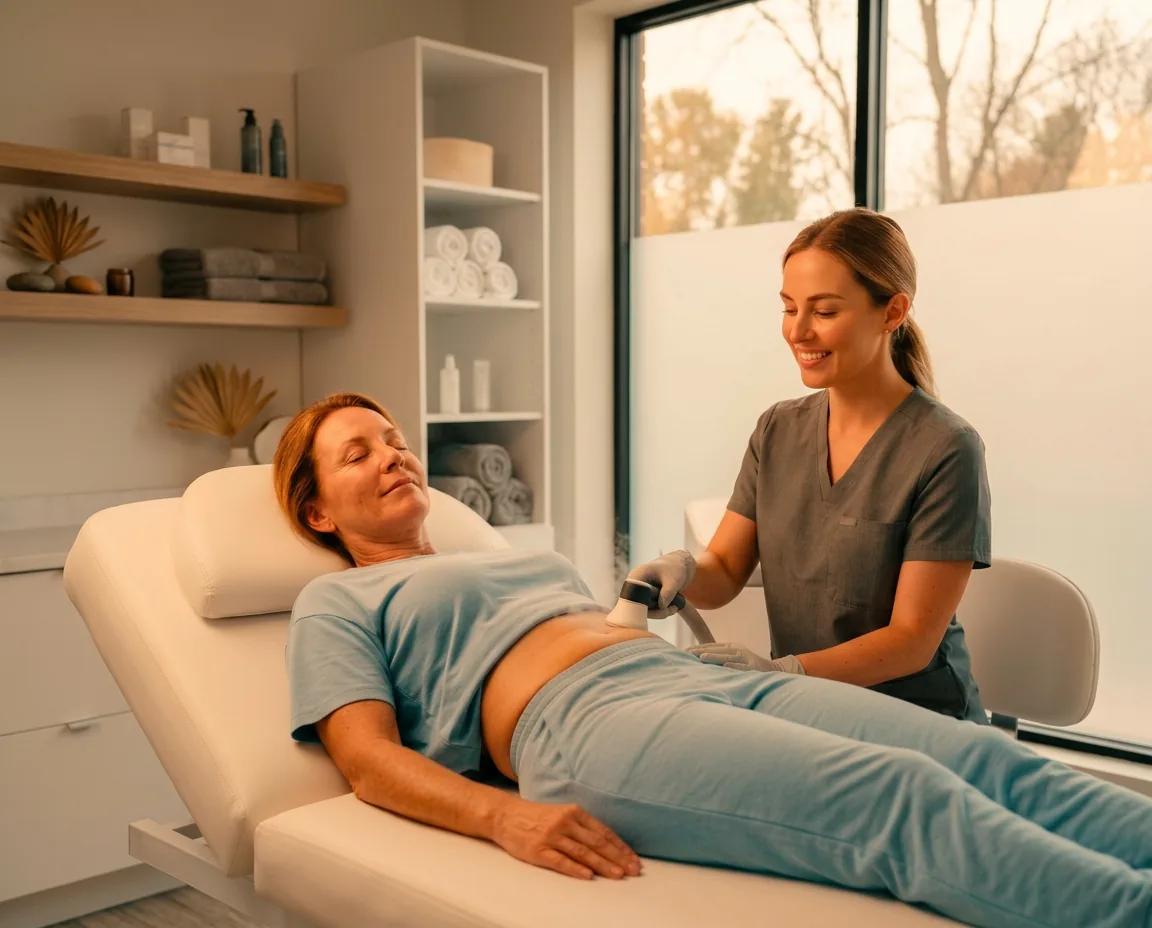
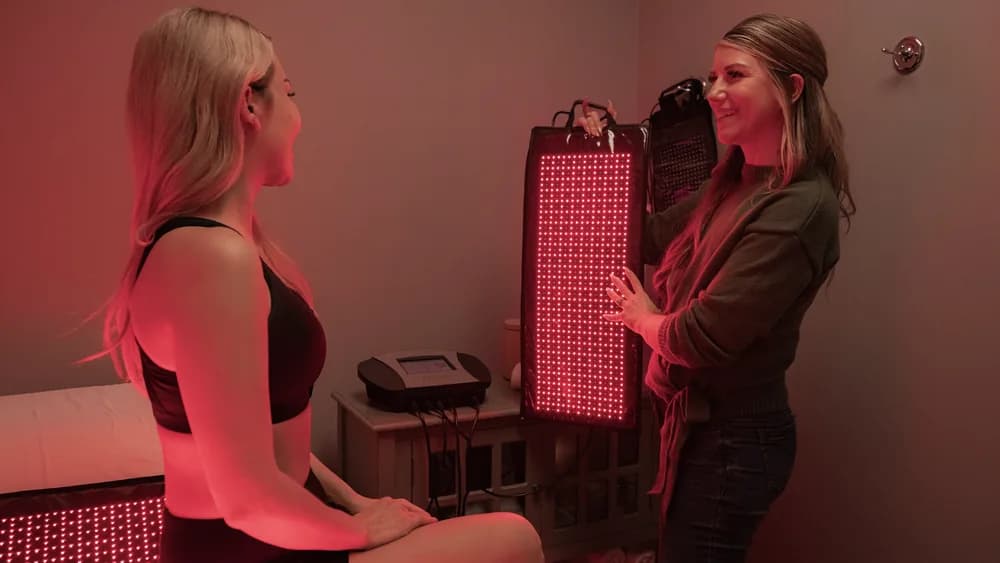
You lie comfortably on a treatment table, fully clothed or with the treatment area exposed depending on what is being targeted. Specialized light pads sit on the areas being worked on: abdomen, hips, thighs, lower back, shoulders, knees, face. The pads emit a steady, gentle warmth. Most clients say it feels like being wrapped in a warm blanket. There is no UV light, no pain, no zapping or pinching. Many clients bring headphones and a podcast. More than a few fall asleep.
The light portion runs about 20 minutes. After that, you step onto our whole-body vibration platform for 10 minutes, which helps move lymphatic fluid and supports the cellular work the light just kicked off. You walk out, get in your car, and go on with your day. There is no downtime.
For most goals, we recommend sessions about three times a week, with roughly 48 hours between visits to let the cellular work do its thing. Treatment plans typically run a few weeks, sometimes longer for collagen-focused goals, where the most visible changes tend to show up after several weeks of consistent sessions.
The Quiet Benefit: Mood, Stress, and Why People Stay
If you ask our clients what keeps them coming back for red light therapy, the answer is rarely about inches or wrinkles. It is about how it makes them feel.
Red light therapy has a real, measurable effect on mood and stress. The same mitochondrial work that powers cellular repair also seems to support neurotransmitter balance and downregulate the body's stress response, which is why a growing body of research is looking at red and near-infrared light for low mood, anxiety, and burnout. Most clients can feel the shift before they can name it. A session leaves you calmer. The week feels easier. The grit you needed for everything feels just a little less hard to find.
This is also where the body-composition piece quietly reconnects. Chronic stress and the cortisol that comes with it work directly against fat loss, sleep, hormone balance, and recovery, no matter how well you are eating or training. Anything that meaningfully lowers your day-to-day stress load is doing more for your weight loss goals than it gets credit for. Red light therapy is one of the gentlest, lowest-effort interventions we have for it.
A practical pattern we see often: the physical reason a client comes in, a stubborn area, a sore knee, slow recovery from workouts, usually resolves inside the first 20 sessions or so. The reason they renew their package after that is almost always how much calmer and clearer they feel between the sessions.
Why It Pairs So Well with Cryo Body Sculpting
If you are already in the body sculpting conversation, you have probably heard us talk about cryo, and you may be wondering how the two relate. They are not redundant. They do very different jobs, and red light therapy quietly amplifies the work cryo starts.
Cryo body sculpting uses controlled cold to target and destroy a portion of the fat cells in a treated area. Once those cells are damaged, the real work shifts to your lymphatic system, which has to break the fat cells down and carry the debris out of the body over the days and weeks that follow. That clearance phase is what determines how much of the change you actually see in the mirror. If the lymphatic system is sluggish, results come slower and feel less dramatic, even when the cryo itself worked exactly as it should.
Red light therapy is one of the most effective lymphatic stimulators we have. The same wavelengths that boost cellular energy also support lymphatic flow, which helps the body move and process the fat cell debris cryo leaves behind. At the same time, red light is stimulating collagen and elastin in the skin overlying the treated area, so the surface keeps pace with the changes happening underneath.
Put plainly: cryo creates the work, red light helps the body finish it. Clients who pair the two consistently tend to see results show up in their progress pictures sooner, and with smoother, firmer skin to go along with the fat reduction. Combo packages are available, and a quick consultation can help you figure out what makes sense for your specific goals.
Honest Caveats and Who Should Check In First
A few groups should talk to their healthcare provider before starting red light therapy:
- Anyone who is pregnant
- Anyone with active cancer or a recent cancer diagnosis
- Anyone taking photosensitizing medications (some acne medications, certain antibiotics, some psychiatric and heart medications)
- Anyone who has had recent steroid injections in the area you want to treat
- Anyone with a serious skin condition or recent skin surgery in the treatment area
None of these are automatic disqualifiers. They are conversations to have first.
It is also worth saying clearly: red light therapy is a wellness tool, not a weight-loss treatment. It is not a shortcut, and it will not undo a pattern of eating that is working against you. The changes it supports, smoother skin, calmer joints, better recovery, modest improvements in measurements, are real, but they need consistent sessions and a healthy lifestyle to stick. Think of it the same way you think about a great skincare routine: it works because you do it, and you do it because it works.
What to Do Next
If red light therapy sounds like something worth folding into a body sculpting or wellness routine, the red light therapy service page is the place to dig deeper. It walks through the benefits, the protocols, the frequently asked questions, and what a typical first session looks like.
Want to talk it through with a real person before you commit? Book a free consultation and we will walk through your goals, what red light therapy can realistically do for you, and how it might fit alongside cryo or the ShiftSetGo program.
Feel better. Recover faster. Look your best. That is the whole point.
Sources
- Hamblin MR. Mechanisms and Mitochondrial Redox Signaling in Photobiomodulation. Photochemistry and Photobiology, 2018. https://pmc.ncbi.nlm.nih.gov/articles/PMC5844808/ ↩
- Wunsch A, Matuschka K. A Controlled Trial to Determine the Efficacy of Red and Near-Infrared Light Treatment in Patient Satisfaction, Reduction of Fine Lines, Wrinkles, Skin Roughness, and Intradermal Collagen Density Increase. Photomedicine and Laser Surgery, 2014. https://pmc.ncbi.nlm.nih.gov/articles/PMC3926176/ ↩
- Clijsen R, Brunner A, Barbero M, Clarys P, Taeymans J. Effects of low-level laser therapy on pain in patients with musculoskeletal disorders: a systematic review and meta-analysis. European Journal of Physical and Rehabilitation Medicine, 2017. https://pubmed.ncbi.nlm.nih.gov/28145397/ ↩
- Jackson RF, Dedo DD, Roche GC, Turok DI, Maloney RJ. Low-level laser therapy as a non-invasive approach for body contouring: a randomized, controlled study. Lasers in Surgery and Medicine, 2009. https://pubmed.ncbi.nlm.nih.gov/20014253/ ↩